
What is Akal Takht? History, Meaning, and Significance in Sikhism
The Akal Takht, or 'Throne of the Timeless One,' is the supreme seat of temporal authority in Sikhism. Located opposite the Golden Temple, it symbolizes divine justice and the concept of Miri-Piri (spiritual and temporal power).
" This article is structured with targeted keywords, engaging subtitles, and clear formatting to rank well on search engines while keeping readers deeply engaged.
What is Akal Takht? Its Significance in Sikhism and Complete History
In Sikhism, the concept of a 'Takht' (throne) extends far beyond mere worldly royalty or political power. It represents divine justice, absolute sovereignty, and spiritual freedom. While there are five major Takhts (seats of temporal authority) in Sikhism, Sri Akal Takht Sahib stands as the supreme and central throne.
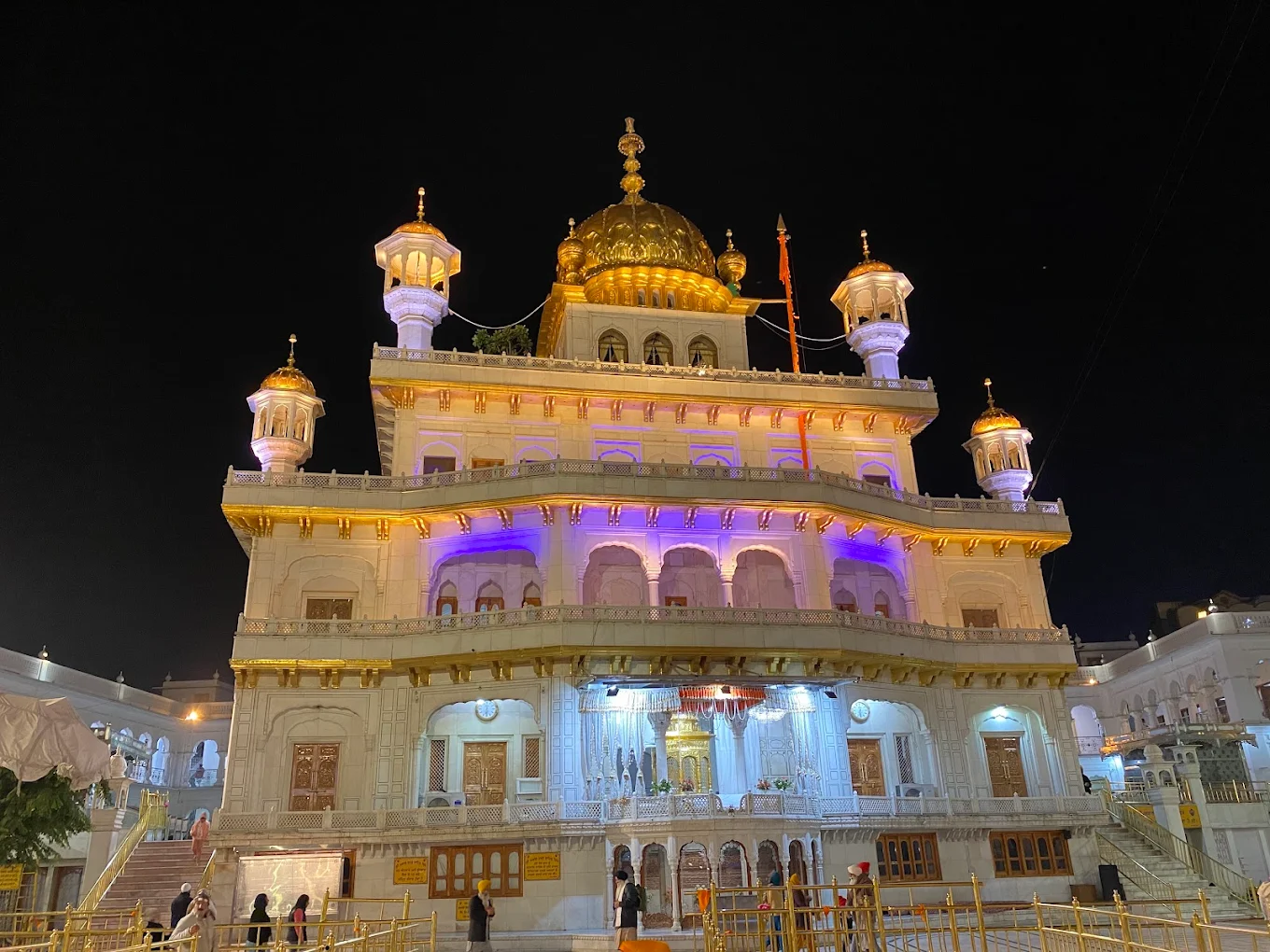
Situated directly opposite the Sri Harmandir Sahib (The Golden Temple) in Amritsar, Punjab, this magnificent institution is the ultimate symbol of the Sikh community’s resilience, sovereign identity, and the unique synthesis of Miri-Piri (temporal power and spiritual authority).
In this detailed blog, we will explore what the Akal Takht is, its profound spiritual and institutional significance in Sikhism, and its glorious yet turbulent history.
1. What is Akal Takht?
The word 'Akal' translates to "The Timeless One" or "Eternal" (referring to God), and 'Takht' means "Throne." Therefore, 'Akal Takht' literally translates to "The Throne of the Timeless One" or the "Throne of the Almighty."
Unlike the thrones of worldly kings and emperors, the Akal Takht represents the court of the Ultimate Sovereign. A striking architectural and spiritual contrast exists within the Golden Temple complex:
Sri Harmandir Sahib is the center of Piri (spirituality), radiating humility, devotion, meditation, and peace.
Sri Akal Takht Sahib is the center of Miri (temporal power), representing political sovereignty, justice, and the defensive strength of the Sikh nation.
Established in 1606 CE by the sixth Sikh Guru, Sri Guru Hargobind Sahib Ji, the Akal Takht delivers a powerful message to the world: a true Sikh must balance inner spiritual reflection with the active social responsibility to stand against tyranny and fight for justice.
2. The Philosophy of Miri-Piri: The Foundation of the Throne
To truly understand the Akal Takht, one must understand the core Sikh doctrine of Miri-Piri. When Guru Hargobind Sahib Ji acceded to the Guruship following the martyrdom of his predecessor, he departed from the traditional practice of wearing a simple wool meditation cord (seli-topi). Instead, he donned two swords:
The Sword of Piri: Symbolizing spiritual authority, inner purity, and the path of meditation (Naam Simran).
The Sword of Miri: Symbolizing temporal power, political sovereignty, community defense, and social justice.
While Harmandir Sahib is dedicated solely to the singing of divine hymns (Kirtan), the Akal Takht handles the collective socio-political affairs, defensive strategies, and legal matters of the community. In Sikh philosophy, these two are inseparable, ensuring that political power remains tightly bound to moral and ethical values.
3. Significance of Akal Takht in Sikhism
The Akal Takht holds the position of supreme authority within the global Sikh community (Sikh Panth). Its core institutional functions include:
A. The Supreme Court of the Sikhs
The Akal Takht acts as the highest judicial body for the global Sikh population. Whenever disputes arise regarding the interpretation of Sikh scriptures, religious codes, or panthic traditions, the final verdict is pronounced from the Akal Takht. This judgment is binding upon every Sikh.
B. Issuance of Hukamnamas (Divine Decrees)
The chief custodian of the Akal Takht, known as the Jathedar, convenes with the Panj Pyaras (five designated senior Sikhs) to deliberate on crucial matters. Following a consensus, they issue a Hukamnama—an official religious edict or decree. For centuries, these decrees have provided moral and practical guidance to the community during times of crisis.
C. The Tradition of Sarbat Khalsa
Historically, whenever the Sikh nation faced an existential threat, democratic assemblies of all Sikh factions and organizations were called at the Akal Takht. This assembly is called the Sarbat Khalsa. The resolutions passed democratically during this gathering are called Gurmata (the counsel of the Guru), which are then broadcasted globally as a Hukamnama.
D. The Anchor of Global Sikh Unity
Sikhs worldwide may hold differing political, social, or personal views, but they all bow to the institutional authority of Sri Akal Takht Sahib. It serves as the ultimate anchor that binds a highly decentralized global diaspora into a single cohesive brotherhood.
4. The Glorious History of Sri Akal Takht Sahib
The history of the Akal Takht is a gripping saga of sacrifice, unwavering faith, and defiance against tyrannical empires. Its evolution can be mapped across four distinct historical eras:
I. The Foundation and Early Era (1606 CE)
The martyrdom of the fifth Sikh Guru, Sri Guru Arjan Dev Ji, under the orders of the Mughal Emperor Jahangir, marked a massive turning point in Sikh history. Recognizing that peaceful meditation alone would not stop state-sponsored genocide, the young Guru Hargobind Sahib Ji laid the foundation for a defensive military posture.
The Defiant Structure: The Guru constructed a raised platform directly facing the Harmandir Sahib. It was deliberately built to a height of 12 feet. Under Mughal law, only the Emperor was permitted to sit on a raised throne higher than three feet; building this was an open declaration of spiritual and political independence from Delhi.
Built by the Pure: Rejecting outside labor, the platform's foundation was laid personally by Guru Hargobind Sahib Ji, and its construction was completed exclusively by two revered Sikh figures: Baba Buddha Ji and Bhai Gurdas Ji.
The Court in Action: Here, the Guru held court, received political emissaries, trained Sikhs in martial arts (Gatka), and listened to bards singing heroic ballads (Dhadi Vaars) to instill courage in the community.
II. The Misls and the 18th-Century Struggle
During the 18th century, the Mughals and Afghan invaders (such as Ahmad Shah Abdali) launched brutal campaigns to exterminate the Sikhs. Driven into the forests and mountains, the Sikhs organized themselves into military confederacies called Misls.
The Targets of Abdali: Recognizing that the Golden Temple and the Akal Takht were the heartbeat of Sikh resistance, Ahmad Shah Abdali attacked the complex multiple times, blowing up the Akal Takht building with gunpowder and filling the sacred pool with debris.
The Resurrection: The defensive strategy of the Sikhs was fueled by a fierce resilience. As soon as the invading armies retreated, the Sikh warriors would emerge from the forests, assemble at the ruined site, and collectively rebuild the Akal Takht. By 1765, the Misls had fully restored the structure to its grand stature.
III. The Era of Maharaja Ranjit Singh (The Sikh Empire)
With the rise of the sovereign Sikh Empire under the leadership of Maharaja Ranjit Singh, the Akal Takht received major patronage. The upper stories of the structure were constructed, and the building was adorned with gold plating and intricate marble work.
Justice Over the King: Despite being an absolute emperor, Maharaja Ranjit Singh humbled himself before the Akal Takht. When the legendary Jathedar of the Akal Takht, Akali Phula Singh Ji, found the Maharaja guilty of a moral and religious infraction, he sentenced the Emperor to be tied to a tree and publicly flogged. Displaying profound humility, the Maharaja accepted the punishment without protest, demonstrating that no king or politician is above the law of the Akal Takht.
IV. The Modern Era and Operation Blue Star (1984)
The darkest chapter in the modern history of the Akal Takht unfolded in June 1984. The Indian government launched a massive military assault code-named Operation Blue Star.
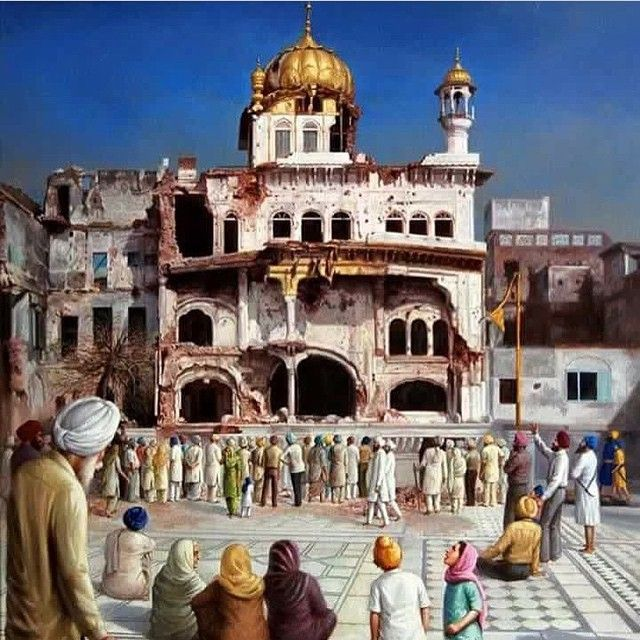
Severe Destruction: The military operation involved heavy artillery and battle tanks inside the sacred complex. The intense shelling reduced the historic edifice of the Akal Takht to rubble and set fire to priceless historical archives.
Rejecting Government Intervention: In an effort to pacify the outraged global Sikh community, the Indian government quickly rebuilt the Akal Takht using state-funded contractors. However, the Sikh community overwhelmingly rejected this government-built structure, viewing it as a symbol of state overreach.
Rebuilt by the Community: In the years that followed, the Sikh community demolished the state-built structure and rebuilt Sri Akal Takht Sahib from the ground up through Kar Seva (voluntary community labor), restoring the throne via the collective hands of the faithful.
5. Architectural Contrast: Harmandir Sahib vs. Akal Takht
The deliberate layout of the two central institutions carries a deep philosophical message:
FeatureSri Harmandir SahibSri Akal Takht SahibCore ConceptSpiritual Authority (Piri)Temporal & Political Power (Miri)ElevationBuilt lower than the surrounding ground level (Symbolizing humility and equality).Built on a highly raised platform (Symbolizing justice, strength, and authority).Primary ActivityContinuous devotional singing (Kirtan); no weapons or political speeches are permitted.Holding assemblies, preserving historical weapons, and addressing socio-political issues.
The modern five-story structure of the Akal Takht features a beautiful golden dome. The ground floor houses the historic weapons used by the Sikh Gurus and legendary warriors, which are reverently displayed to the congregation (Sangat) every evening.
6. Daily Protocol and Code of Conduct
The Akal Takht operates under a strict, centuries-old protocol:
Every night, the holy scripture, Sri Guru Granth Sahib Ji, is brought from the Golden Temple in a golden palanquin (Palki Sahib) to a special room inside the Akal Takht called the Kotha Sahib for its nightly rest (Sukhasan).
Decisions made at the Akal Takht are never driven by individual political interests; they are vetted against the touchstone of scriptural teachings and the long-term well-being of the global community.
Conclusion
Sri Akal Takht Sahib is not merely an architectural monument made of brick and marble; it is the living soul, conscience, and sovereign backbone of the Sikh community. For over four centuries, it has stood as a beacon of resistance against oppression, reminding humanity that spiritual evolution must always be accompanied by a commitment to social justice.
Even today, no matter where a Sikh resides—be it India, Canada, the UK, or the US—their eyes remain fixed toward Sri Akal Takht Sahib for moral, ethical, and communal guidance. Protecting its integrity and honoring its historical code remains a sacred duty for every Sikh.