
History of Gurudwara Sri Panjokhra Sahib | Sakhi Guru Har Krishan Sahib Ji
Learn about Gurudwara Panjokhra Sahib, a sacred place tied to the inspiring Sakhi of Guru Har Krishan Ji. At just five, the 'Bal Guru' displayed immense spiritual wisdom, teaching a timeless lesson of humility over ego.
This is the beautiful, deeply moving Sakhi of our eighth Guru, Sri Guru Har Krishan Sahib Ji. Throughout history, he has been lovingly remembered as the Bal Guru (the Child Guru) or Bala Pir (the Child Prophet). These titles were given to him because he was entrusted with the spiritual leadership and responsibility of the entire Sikh community when he was just five years old. It is hard for our human minds to wrap around how a child so young could hold such immense cosmic responsibility. Yet, while his time on this earth was physically brief, his spiritual wisdom was as vast, deep, and unshakeable as the ocean.
Every single step he took during his short life left an permanent mark on history, teaching humanity timeless lessons about love, humility, equality, and the absolute power of divine grace over human ego.
The Journey to Delhi
In the year 1661, major political and spiritual trouble began brewing in the background of the Sikh house. When the seventh Guru, Sri Guru Har Rai Sahib Ji, passed the divine light of Guruship to his younger son, Guru Har Krishan Ji, it sparked a deep, bitter anger in his eldest son, Ram Rai. Ram Rai believed that he was the rightful heir to the spiritual throne of Guru Nanak Dev Ji simply by birthright. Blinded by envy, he traveled to Delhi to align himself with the powerful and ruthless Mughal Emperor, Aurangzeb. Ram Rai formally petitioned the imperial court to intervene, claiming that a grave injustice had been committed against him.
Emperor Aurangzeb, a master politician, saw this family dispute as the perfect opportunity to interfere with the rapidly growing and increasingly influential Sikh community. He wanted to place a leader on the spiritual throne whom he could easily manipulate and control. Consequently, Aurangzeb issued an imperial decree summoning the young Guru Har Krishan Ji to his court in Delhi.
When the summons arrived, the young Guru faced a profound dilemma. His father, Guru Har Rai Ji, had given him explicit, strict instructions before passing away: he was never to look upon the face of the tyrannical emperor, nor was he to let the Mughal court meddle in the pure, independent affairs of the house of Nanak. However, back in Delhi, the local Sangat (the congregation of devotees) was terrified. They knew how brutal Aurangzeb could be, and they feared a violent imperial crackdown on innocent Sikhs if the Guru outright refused to come.
They sent urgent messages and sincere emissaries to Kiratpur Sahib, begging the Guru to make the journey. Along with the Sangat, a wealthy, highly respected, and politically powerful Rajput king named Raja Jai Singh of Amber stepped forward. Raja Jai Singh promised the community that he would personally handle all the logistics, host the young Guru as an honored royal guest in his own palace, and act as a strong, protective buffer between the Guru and the Mughal emperor.
Seeing the deep anxiety, love, and fear of his beloved Sangat, the young Guru agreed to make the journey. He decided that he would travel toward Delhi to comfort his devotees, but he would remain steadfast in his father’s instruction never to meet the emperor face-to-face.
When Guru Har Krishan Ji finally rode out of the town of Kiratpur Sahib, the scene was absolutely heartbreaking. Thousands of men, women, and children burst into tears. They simply could not bear the thought of letting their young spiritual guide out of their sight, especially when he was heading toward the dangers of Delhi. Driven by pure devotion, the crowd refused to turn back. They packed up small bags and followed his horse down the dusty roads, walking step-for-step with the Guru’s entourage.
Guru Ji traveled slowly through the regions of Ropar, Banur, Rajpura, and Ambala, spending his days comforting the frightened masses, distributing blessings, and teaching them the core values of life. Yet, the crowd only grew larger as more people joined from neighboring villages. By the time the Guru reached a quiet, small village called Panjokhra—located roughly 8 kilometers from Ambala—the gathering had turned into a massive, unmanageable sea of people.
Realizing that this immense crowd could not possibly accompany him all the way to Delhi, Guru Ji halted his horse. He stood before the weeping, exhausted congregation, looked at them with eyes full of deep compassion, and told them gently but firmly that it was time for them to return to their homes and families.
Seeing their hesitation, he reminded them of a fundamental spiritual truth that many often forget:
"The Guru's blessing and protection are not tied to a physical body or a specific geographic location. The divine light travels with you in your heart, no matter how many miles lie between us."
Comforted and reassured by his powerful words, the devotees found the strength to say goodbye. They bowed to their young Guru, turned around, and finally began the long walk back to their villages.
A Scholar Full of Pride
Guru Har Krishan Ji decided to set up camp and rest in Panjokhra for a few days. Naturally, news of the "child Guru's" presence spread like wildfire through the entire countryside. Living in that very village was a man named Pandit Lal Chand. Lal Chand was an incredibly well-read, highly orthodox Brahmin scholar. He had spent his entire life studying the ancient scriptures, mastering the Sanskrit language, and memorizing complex theological philosophies. He was widely respected for his massive intellect, but all that academic reading had fed a severe, deep-seated spiritual disease: absolute pride. He had become completely blind to his own arrogance, firmly believing that his high caste and scholastic education made him superior to everyone else.
When Lal Chand heard the rumors that a mere seven-year-old child was sitting on the sacred Gaddi (the spiritual throne) of the legendary Guru Nanak, he laughed out loud. He scoffed at the idea and found it deeply offensive to his intellectual sensibilities. How could a young boy who hadn't spent decades reading heavy books possibly understand the mysteries of the universe?
Driven by pure ego, Lal Chand marched over to the Guru’s open camp. He didn't go there with an open mind to listen or learn; he went with the explicit intention of publicly humiliating the child and exposing him as a fraud in front of his followers.
He aggressively pushed his way through the quiet, meditative gathering of devotees, walked right up to the front, and looked down at the young Guru sitting calmly on the diwan. Smirking arrogantly, he remarked mockingly:
"It is claimed by your followers that you occupy the spiritual seat of Guru Nanak and that you call yourself 'Har Krishan.' The ancient Lord Krishna of antiquity authored the profound, highly complex philosophy of the Bhagavad Gita. If you are truly brave enough to carry his sacred name and claim divine authority, come forward right now. Translate and debate the hidden meanings of the most difficult Gita verses with me."
The moment the words left his mouth, the entire assembly went dead silent. You could have heard a pin drop. The devotees held their breath, instantly recognizing that this intellectual challenge was a deliberate, dangerous trap meant to pit rigid scholastic authority against a young child.
The Unlikeliest Scholar
Sri Guru Har Krishan Ji did not get angry, nor did he display any defensive behavior. He didn't flinch under the scholar’s mocking glare. Instead, embodying the serene composure, infinite patience, and supreme confidence of the house of Nanak, he looked up at the proud pandit with a calm, gentle smile.
Guru Ji spoke softly, yet his voice carried an undeniable authority that echoed through the quiet camp:
"Pandit Ji, if I sit here and translate or interpret these complex texts for you myself, you will not accept it as divine truth. Your pride will make you rationalize it. You will simply claim that I am the privileged son of a noble Guru's family and that I was quietly tutored by expensive private scholars behind closed doors. You will say the child was coached well. Therefore, let us settle this differently: go out into the village square right now. Bring back the very first person you lay your eyes on, and by the grace of the Almighty, that person will answer your questions and decode the Gita for you."
Lal Chand stared at the Guru, convinced that the boy was bluffing to save face. Believing he had completely trapped the Guru, and determined to make the humiliation absolute and permanent, Lal Chand turned on his heel and walked out into the village. He wasn't looking for just anyone; he actively searched for the least intelligent, most uneducated, and most marginalized person he could find to ensure the Guru’s absolute failure.
After looking around the village square for a few moments, his eyes landed on a man named Chhaju Ram.
Chhaju was a poor village water-carrier (Gheera). He belonged to a heavily marginalized, lower caste, meaning he had never been allowed to step foot inside a school or touch a religious text. He was completely illiterate. But to make Lal Chand's trap absolutely flawless, Chhaju was also completely deaf and mute from birth. He could not hear a single word, nor could he speak a single sound.
Laughing mockingly to himself at his own cleverness, Lal Chand grabbed Chhaju Ram by the arm and dragged the confused water-carrier into the crowded assembly of the Guru. He pushed Chhaju to the front, turned to Guru Ji, and confidently declared to the crowd:
"Here is your grand scholar! Let us see this man explain the deepest, most complex philosophy known to mankind."
A Simple Stick and Divine Grace
The young Guru looked upon the humble, frightened, and thoroughly confused water-carrier with eyes full of absolute, unconditional love. He didn't see a low-caste, disabled man; he saw a pure soul. Guru Ji gestured to Chhaju Ram, instructing him to go to a nearby pool of water to wash his face, hands, and feet.
When Chhaju returned, clean and calm, he sat down on the floor directly in front of the assembly. Guru Har Krishan Ji then stepped forward. He reached out and took a simple, ordinary wooden walking stick (Chaddi) that was resting nearby. Moving with absolute grace, the young Guru gently placed the tip of the wooden stick on top of Chhaju Ram's head.
What happened in the next split second sent shockwaves through the physical body of every single person present in that room. It is an event that defied all laws of science, medicine, and human logic.
The exact moment that the wooden stick touched the crown of his head, something monumental unlocked within Chhaju Ram’s consciousness. The physical boundaries of speech and hearing that had locked him in silence his entire life instantly dissolved. The dark clouds of illiteracy vanished as his spiritual vision was blown wide open under the crushing weight of cosmic awareness. His posture straightened, his eyes cleared, and his entire face became illuminated with a brilliant, undeniable divine radiance. He was no longer just a village water-carrier; he had been transformed into a vessel of infinite knowledge.
Pandit Lal Chand, still skeptical but slightly unnerved by the sudden change in the man's expression, decided to test him. He stepped forward and loudly recited a highly abstract, grammatically complex verse from the Bhagavad Gita in classical Sanskrit—a verse that took ordinary scholars years of intense university study to properly comprehend.
Without a single second of hesitation, hesitation, or stuttering, Chhaju Ram opened his mouth.
To the absolute horror and amazement of Lal Chand, Chhaju began to speak in flawless, elegant, and perfectly pronounced Sanskrit. His voice was steady and resonant. He did not merely translate the literal words of the verse; he began to expound upon the inner philosophical core of the text. He broke down the concepts with such profound depth, mystical clarity, and breathtaking insight that the greatest academic minds of the region could never have hoped to match his explanation.
Chapter after chapter, verse after verse, the illiterate, deaf-mute water-carrier laid bare the universal truths of creation, the nature of the soul, the duty of a human being, and the concept of detached action. He spoke as if he had authored the texts himself.
The Lesson of the Sand
Pandit Lal Chand was completely, utterly shattered. The heavy books he had memorized, the high-caste titles he proudly carried, the societal status he had used as a shield—all of it felt completely empty, hollow, and meaningless in that single second. He realized with absolute clarity that true spiritual wisdom is not a commodity that can be bought with expensive schooling, memorized through books, or inherited by belonging to a specific caste. It is a direct, humbling gift of divine grace (Nadar), and it can choose any vessel it wishes.
Trembling from head to toe, tears of deep shame and intense remorse streaming down his face, the proud scholar collapsed to the floor. He threw himself at the holy feet of the seven-year-old Guru, weeping uncontrollably and begging for forgiveness for his blind arrogance.
Guru Har Krishan Ji, showing the true heart of a spiritual master, did not humiliate him further. He gently reached down, helped the weeping pandit up to his feet, and left him—and all of us—with a profound lesson that remains essential for humanity today:
"Lal Chand, knowledge should breed humility, love, and compassion in your heart, not pride. The moment ego enters the mind, true learning and spiritual light leave. Never use your intellect to look down on others. Use your mind to serve humanity, and learn to see the same divine light within every single human being, regardless of their caste, status, or background."
That single day completely transformed Lal Chand from the inside out. He renounced his pride, gave up his high-caste prejudices, and became a deeply devoted disciple of the Guru. He packed his bags and escorted Guru Har Krishan Ji all the way to Kurukshetra, dedicating the remainder of his long life to preaching the egalitarian, beautiful message of Sikhism. Historical records note that decades later, during the time of the tenth Guru, Sri Guru Gobind Singh Ji, this very same Lal Chand entered the fold of the Khalsa, took the name Bhai Lal Singh, and died a hero’s death fighting bravely for righteousness at the historic Battle of Chamkaur in 1705.
Before leaving the village of Panjokhra to resume his fateful journey toward Delhi, Guru Har Krishan Ji decided to leave a permanent blessing for the land and its people. He took his wooden walking stick, drew a distinct, clear boundary line in the dry sand, and declared that any devotee who approached this specific spot with a pure, faithful, and humble heart, stood within this perimeter, and made a sincere prayer (Ardas) from the depths of their soul, would find absolute spiritual solace, mental peace, and have their righteous wishes fulfilled by the Almighty.
Shortly after leaving Panjokhra, Guru Ji arrived in Delhi. True to his father’s word, he never met Emperor Aurangzeb. Instead, he chose to spend his days and nights in the streets, tending directly to the poorest citizens who were suffering through a horrific, deadly epidemic of smallpox and cholera. He served the diseased, washed their wounds, and gave them water completely unmindful of his own health and safety, earning the title "Bala Pir" (the Child Saint) from the local Muslim population who witnessed his boundless mercy.
Eventually, the young Guru contracted the deadly disease himself. At the tender age of seven and a half, he consciously chose to shed his physical mortal frame, passing the divine spiritual light of Guruship to his grand-uncle, Guru Tegh Bahadur Ji, with the final words, "Baba Bakala."
Gurudwara Sri Panjokhra Sahib Today
Today, the exact, sacred site where this magnificent historical event took place stands as the glorious Gurudwara Sri Panjokhra Sahib, located prominently on the Ambala-Naraingarh road in Haryana, India. What began centuries ago as a simple, humble mud memorial built by poor villagers has evolved over time into a massive, breathtakingly beautiful spiritual complex.
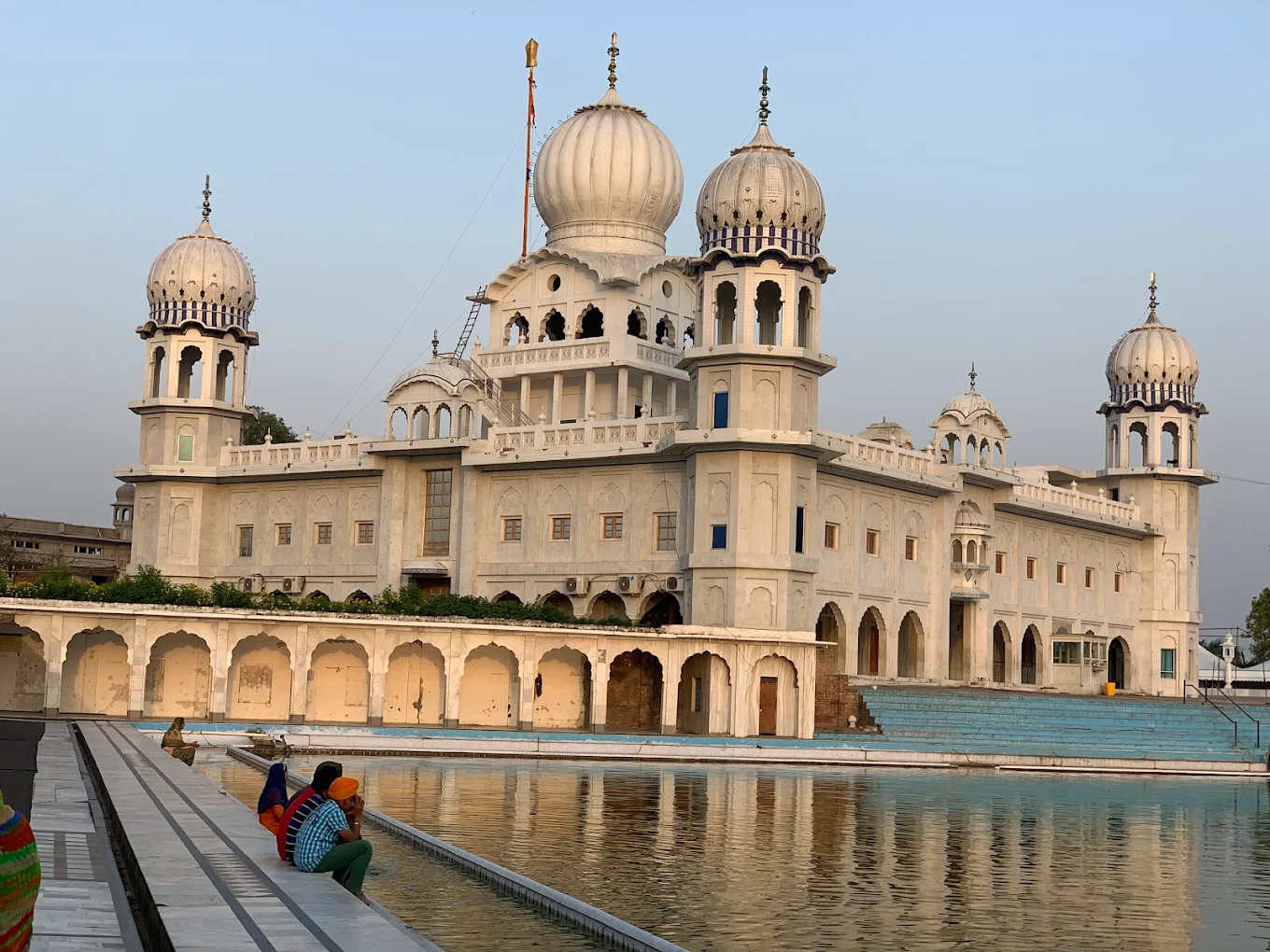
The gurudwara features a stunning, pristine white double-storey sanctum built in traditional Sikh architecture, topped with magnificent golden domes that glisten brightly under the morning sun. The serene, calm surroundings of the shrine are anchored by a massive, beautiful Sarovar (holy pool of water), built precisely on the site of the natural pool where Chhaju Ram took his historic, cleansing bath before speaking to the assembly.
Every single day, but particularly on Sundays, tens of thousands of pilgrims from all over the world flock to this sacred shrine. They come to take a holy dip in the cool waters of the sarovar, close their eyes to listen to the continuous, deeply meditative strains of Gurbani Keertan reflecting off the white marble walls, and walk inside the magnificent Langar hall.
In that hall, the true legacy of the Sakhi comes to life. Rich and poor, scholars and the uneducated, people of every race, caste, and religion sit flat on the floor side-by-side, shoulder-to-shoulder, eating the exact same simple food from the communal kitchen. The artificial lines of human ego, wealth, and social status are completely erased from the room—standing as a living, breathing monument to the timeless lesson that a seven-year-old child Guru taught a proud scholar centuries ago under the shade of a village tree.