
Gurdwara Gwari Ghat Sahib, Jabalpur: Guru Nanak Dev Ji’s
Discover the history and spiritual significance of Gurdwara Gwari Ghat Sahib in Jabalpur, a sacred Sikh site on the banks of the Narmada River associated with the travels of Sri Guru Nanak Dev Ji and Bhai Mardana Ji. Explore its connection with Guru Sahib’s Udasis and its enduring traditions of Gurbani, Langar, Sangat, equality, compassion and selfless service
On the peaceful banks of the sacred River Narmada in Jabalpur, Madhya Pradesh, stands a place that carries a remarkable connection with Sikh history: Gurdwara Gwari Ghat Sahib.
Gwarighat is one of the well-known spiritual locations of Jabalpur. For generations, people have visited the banks of the Narmada for prayer, pilgrimage and reflection. Yet within this ancient religious landscape lies another important chapter—the Sikh tradition connecting Gwarighat with Sri Guru Nanak Dev Ji, the founder and first Guru of Sikhism.
According to Sikh historical tradition, Guru Nanak Dev Ji travelled through this region during his extensive journeys across the Indian subcontinent. Accompanied by Bhai Mardana Ji, Guru Sahib is traditionally believed to have reached the Narmada and crossed the river at Gwarighat.
The Gurdwara that stands here today preserves the memory of this journey.
But the importance of Gurdwara Gwari Ghat Sahib goes beyond the historical question of where Guru Nanak Dev Ji travelled. Its deeper significance lies in the message represented by those journeys—a message of equality, compassion, remembrance of the Divine, honest living, sharing and selfless service.
Today, through Gurbani, Sangat, Guru Ka Langar and seva, Gurdwara Gwari Ghat Sahib continues to reflect those values.
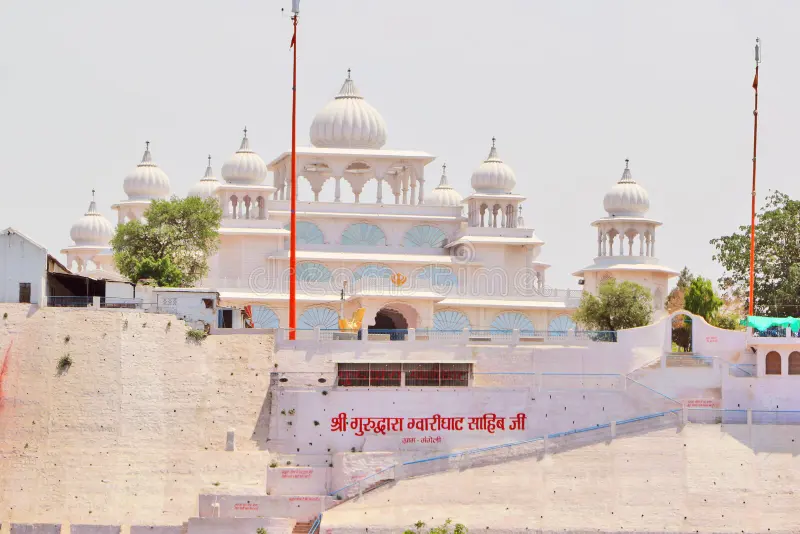
The Ancient Spiritual Landscape of Gwarighat
To understand the importance of Gurdwara Gwari Ghat Sahib, it is helpful to first understand Gwarighat itself.
Situated along the Narmada River in Jabalpur, Gwarighat has long been associated with religious activity and pilgrimage.
The Narmada is among India's most revered rivers. Flowing through central India, it has influenced the religious, cultural and geographical history of the region for centuries.
Gwarighat developed as an important location along its banks.
The area was not significant only for religious reasons. Historically, river crossings were important parts of travel routes. Traditional accounts describe Gwarighat as a crossing point on routes connecting Jabalpur towards Nagpur and other parts of central India.
Travellers, pilgrims, spiritual seekers and merchants would have depended on such crossings during journeys that were far more difficult than modern travel.
It is within this historical landscape that Sikh tradition places the journey of Guru Nanak Dev Ji.
Today, visitors to Gwarighat encounter a diverse spiritual environment. The riverbank is associated with temples, religious ceremonies, Narmada Aarti and several sacred sites.
Gurdwara Gwari Ghat Sahib adds an important Sikh historical dimension to this ancient landscape.
Guru Nanak Dev Ji and the Udasis
Guru Nanak Dev Ji was born in 1469.
His teachings would eventually lay the spiritual foundation of Sikhism, but Guru Sahib did not limit his message to one town, region or community.
He travelled extensively.
These journeys are traditionally known as the Udasis.
At a time when journeys of hundreds or thousands of kilometres required extraordinary physical endurance, Guru Nanak Dev Ji travelled across vast regions.
He encountered people belonging to different religions, occupations, communities and social positions.
He met spiritual seekers and ordinary householders. He interacted with religious scholars, ascetics, rulers, labourers and communities living far from Punjab.
These journeys were not simply geographical exploration.
They carried a spiritual purpose.
Guru Nanak Dev Ji communicated a message centred on the oneness of the Divine and the fundamental equality of humanity.
He challenged social discrimination and empty ritualism while encouraging people to live truthful, compassionate and spiritually conscious lives.
Several principles associated with Guru Nanak Dev Ji's teachings remain central to Sikh life:
Naam Japna—remembering and meditating upon the Divine.
Kirat Karni—earning one's livelihood honestly.
Vand Chhakna—sharing what one has with others.
These principles transform spirituality from something restricted to ritual into a way of living.
A person remembers the Divine, works honestly and shares with others.
The journey associated with Gwarighat must therefore be understood within this wider mission.
Guru Nanak Dev Ji Reaches the Narmada
According to Sikh historical tradition, Guru Nanak Dev Ji travelled through central India and reached the region surrounding the Narmada.
He was accompanied during many of his travels by Bhai Mardana Ji.
Sikh accounts associate their journey along the Narmada with Gwarighat, identifying it as a place where Guru Nanak Dev Ji crossed the river.
The Sikh historical work Panth Parkash, associated with Giani Gian Singh, is among the traditions referring to Guru Nanak Dev Ji's journey through this region.
This historical association is the principal reason Gwarighat holds significance within Sikh heritage.
Imagine the landscape more than five centuries ago.
There were no highways, railway stations or modern bridges.
A traveller approaching the Narmada would encounter a vast natural barrier that had shaped routes and settlements for generations.
Guru Nanak Dev Ji's journey through such terrain reminds us of the extraordinary distances travelled during the Udasis.
These journeys required endurance, courage and deep commitment.
Yet Guru Sahib continued travelling because his message was intended for humanity rather than one particular geographical community.
Bhai Mardana Ji: Companion of Guru Nanak Dev Ji
The presence of Bhai Mardana Ji is an important part of the story of Guru Nanak Dev Ji's travels.
Bhai Mardana Ji was Guru Nanak Dev Ji's lifelong companion and musician and belonged to a Muslim family.
He travelled alongside Guru Sahib during many journeys.
Their companionship itself communicates something profound about Guru Nanak Dev Ji's teachings.
At a time when society was deeply divided by caste, religion and social hierarchy, Guru Nanak Dev Ji demonstrated through his own life that spiritual companionship was not determined by such boundaries.
Guru Sahib and Bhai Mardana Ji travelled together, faced difficult journeys together and communicated the Divine message together.
Music played an important role in their spiritual communication.
Through sacred compositions and musical expression, spiritual wisdom could reach people in a form that crossed linguistic, social and cultural barriers.
The image of Guru Nanak Dev Ji and Bhai Mardana Ji travelling together through forests, villages, towns, mountains and riverbanks remains one of the most meaningful images associated with Guru Sahib's Udasis.
Their journey to the Narmada fits within this larger tradition of companionship and universal brotherhood.
Guru Nanak Dev Ji and Sarbang Rishi
Another tradition associated with Guru Nanak Dev Ji's journey through the Gwarighat region concerns Sarbang Rishi.
According to Sikh historical accounts, after crossing the Narmada at Gwarighat, Guru Nanak Dev Ji travelled to meet and preach to Sarbang Rishi, a spiritual figure associated with the region.
This tradition reflects an important pattern visible throughout the accounts of Guru Nanak Dev Ji's travels.
Guru Sahib engaged in spiritual dialogue.
He did not travel merely to establish new places of worship or collect followers.
He met spiritual teachers, seekers and communities with different beliefs and encouraged them to consider deeper questions about the nature of God, truth and human existence.
Guru Nanak Dev Ji repeatedly challenged the idea that outward religious identity alone could make a person spiritually complete.
Ritual without compassion was insufficient.
Knowledge without humility was insufficient.
Religious identity without truthful living was insufficient.
The spiritual encounter associated with Sarbang Rishi can therefore be understood as part of Guru Nanak Dev Ji's wider tradition of dialogue.
Gwarighat becomes more than a river crossing.
It becomes a meeting point of spiritual traditions.
What Was Guru Nanak Dev Ji's Message?
When discussing a historical Gurdwara connected with Guru Nanak Dev Ji, it is easy to focus entirely on the physical location.
Where did Guru Sahib sit?
Where did he cross the river?
Which route did he follow?
These questions are important for understanding history.
But another question is even more important:
What did Guru Nanak Dev Ji teach?
The physical journey becomes meaningful because of the spiritual message carried through it.
Guru Nanak Dev Ji taught that humanity ultimately comes from the same Creator.
Social divisions based on caste, wealth, occupation and status cannot determine a person's spiritual worth.
This idea was transformative.
Guru Sahib opposed discrimination and taught people to recognise the Divine presence beyond artificial human divisions.
Naam Japna
Naam Japna means remembering and meditating upon the Divine.
In Sikh spirituality, remembrance is not meant to be restricted to a particular hour of worship.
The Divine should remain present in one's consciousness throughout life.
Spiritual remembrance gradually influences how a person thinks, speaks and behaves.
Kirat Karni
Guru Nanak Dev Ji emphasised honest work.
Spirituality does not require abandoning ordinary responsibilities.
A person can live within society, care for a family, work honestly and still follow a deeply spiritual path.
Kirat Karni teaches dignity of labour and honest livelihood.
Vand Chhakna
Whatever we receive should not be kept only for ourselves.
Vand Chhakna encourages sharing.
Food, resources, time and ability can all be used to help others.
This principle eventually became visibly expressed through Sikh institutions such as Guru Ka Langar.
Together, Naam Japna, Kirat Karni and Vand Chhakna describe a spiritual life that combines remembrance, honest action and compassion.
From Sacred Memory to Gurdwara
The precise date on which the original structure at Gwarighat was established is not clearly documented in the available historical material.
What Sikh historical accounts preserve is the site's association with Guru Nanak Dev Ji's travels.
Over time, locations associated with the Sikh Gurus naturally became places where Sangat gathered.
The physical structures might change across generations, but the historical and spiritual memory remained.
Sant Tulsa Singh Ji is described in accounts of Gwari Ghat Sahib as having performed seva at this sacred location for a long period.
Following his passing, the Sikh Sangat of Jabalpur organised a committee that assumed responsibility for the Gurdwara and its activities.
The site gradually developed not merely as a place for prayer but as an institution serving the community.
This distinction is important.
A Gurdwara is not simply a monument commemorating something that happened centuries ago.
It is a living institution.
People come for Darshan.
They listen to Gurbani.
They participate in Sangat.
They perform seva.
They eat in Langar.
They help others.
In this way, history becomes a living practice.
Seva: The Heart of Sikh Community Life
One of the strongest themes associated with Gurdwara Gwari Ghat Sahib is seva.
Seva means selfless service.
Within Sikh tradition, spirituality and service cannot be completely separated.
Prayer may transform the mind, but that transformation should become visible in how we treat others.
A Gurdwara therefore serves both spiritual and social functions.
Someone entering may come to bow before Guru Granth Sahib Ji.
Another person may come to listen to Kirtan.
A traveller may need food.
A pilgrim may need shelter.
Someone else may simply need human kindness.
All can find a place within the institution of the Gurdwara.
This is why seva remains central to Sikh identity.
The goal is not service for personal recognition.
True seva is performed with humility.
Guru Ka Langar at Gwari Ghat Sahib
Perhaps no Sikh institution communicates equality as visibly as Guru Ka Langar.
Langar is the community kitchen where food is prepared and served without discrimination.
A person's religion does not determine whether they can eat.
Their caste does not matter.
Their wealth does not matter.
Their social status does not matter.
Everyone receives the same food.
Everyone is treated with dignity.
This simple practice contains a powerful spiritual principle.
Human beings may construct hierarchies, but before the Creator they remain equal.
At Gurdwara Gwari Ghat Sahib, the tradition of Langar is particularly meaningful because of the site's historical position along a travel and pilgrimage route.
Travellers arriving at the Narmada could find not merely a Sikh religious site but hospitality.
The Gurdwara thus became a place where Guru Nanak Dev Ji's message could be experienced rather than merely discussed.
A hungry person receiving food understands Vand Chhakna through action.
A wealthy visitor sitting beside an ordinary labourer experiences equality.
A volunteer washing utensils experiences humility.
A traveller receiving hospitality experiences compassion.
This is why Langar is much more than free food.
It is a living expression of Sikh philosophy.
A Place of Shelter for Travellers
Historical descriptions of Gurdwara Gwari Ghat Sahib also mention accommodation for pilgrims and travellers.
A sarai or lodging facility is particularly significant in the context of Gwarighat.
For centuries, travel could be physically exhausting and uncertain.
Religious institutions often served as places where travellers could rest before continuing their journeys.
At Gwari Ghat Sahib, this tradition of hospitality complemented Langar.
Food, shelter, prayer and companionship could all exist within the same space.
This reflects an important idea:
Spiritual institutions should respond to practical human needs.
Someone who is hungry needs food.
Someone who has travelled a great distance may need rest.
Someone facing difficulty may need support.
Someone searching spiritually may need Sangat and Gurbani.
The Gurdwara provides a space in which these different needs can meet.
Free Medical Service and Compassion
Accounts of Gurdwara Gwari Ghat Sahib have also mentioned a homeopathic dispensary offering free medical assistance.
This provides another example of the broader meaning of seva.
Community service need not be restricted to food.
Helping someone who is unwell, supporting someone in difficulty or making useful services accessible to people in need are all expressions of compassion.
Sikh spirituality repeatedly brings the devotee back to humanity.
If remembrance of the Divine does not make us more compassionate toward others, something essential is missing.
This is why institutions connected with Sikh tradition have historically developed many forms of service.
The underlying principle remains simple:
Serving humanity is a form of serving the Divine.
Preserving Sikh Heritage
Gurdwara Gwari Ghat Sahib has also been described as containing a small museum or historical display with paintings and information related to Sikh history.
Such spaces are important, especially in regions far from Punjab.
Sikh history is geographically much broader than Punjab alone.
The travels of Guru Nanak Dev Ji connected Sikh heritage with numerous locations across South Asia and beyond.
Places such as Gwarighat remind visitors that Guru Sahib's message travelled across diverse cultural and geographical landscapes.
Historical displays can introduce visitors to Guru Nanak Dev Ji, the Sikh Gurus, the development of the Sikh Panth, Sikh traditions and important events in Sikh history.
For younger generations, such places can create a tangible connection with history.
Reading about Guru Nanak Dev Ji's travels is one experience.
Standing beside the river traditionally associated with his journey creates another.
The geography makes history feel immediate.
Sangat and the Sunday Diwan
A Gurdwara becomes truly alive through Sangat.
Historical descriptions of Gwari Ghat Sahib mention regular Sunday congregations or diwans.
Devotees gather to listen to Gurbani, Kirtan and teachings connected with Guru Granth Sahib Ji.
The experience of Sangat has a special place within Sikh spirituality.
Spiritual practice can be personal, but Sikh tradition also emphasises collective remembrance.
People sit together.
They listen together.
They participate in Ardas together.
They perform seva together.
They share Langar together.
No one needs a privileged social position to become part of the Sangat.
The congregation itself reflects equality.
Regular diwans ensure that the Gurdwara remains not simply a historical destination for occasional tourists but a living centre for the local Sikh community.
Hola Mohalla at Gwari Ghat
Hola Mohalla is another important occasion associated with the Gurdwara.
The festival has its historical roots in the period of Sri Guru Gobind Singh Ji, the tenth Sikh Guru.
Hola Mohalla came to embody devotion, discipline, courage, preparedness and community spirit.
At Gwari Ghat Sahib, celebrations bring Sangat together and connect a Sikh community in central India with traditions observed by Sikhs around the world.
Festivals in a Gurdwara are not simply occasions for celebration.
They allow generations to gather.
Children observe traditions.
Young people learn history.
Older members of the community share knowledge.
Sangat performs seva.
Langar brings everyone together.
In this way, religious festivals become important vehicles for preserving collective memory.
The Beauty of the Narmada and the Gurdwara
The physical setting of Gurdwara Gwari Ghat Sahib gives the location a distinctive atmosphere.
The Narmada flows beside an ancient spiritual landscape.
The Gurdwara preserves a Sikh historical tradition associated with Guru Nanak Dev Ji.
Around it exists a broader religious culture connected with the river.
These traditions exist within the same geographical space.
For a visitor, this creates an opportunity for reflection.
Rivers have always played an important role in human civilisation.
People settled near them.
Travellers crossed them.
Communities depended upon them.
Religious traditions developed around them.
Guru Nanak Dev Ji's journeys repeatedly took him through landscapes where people had established spiritual customs over generations.
Instead of remaining isolated, Guru Sahib entered these spaces and engaged people in dialogue.
The Narmada therefore serves not merely as a background to the Gwarighat story.
It forms part of the historical context that makes the journey meaningful.
Gwarighat as a Meeting Point of Traditions
One of the most interesting characteristics of Gwarighat is its religious diversity.
The Narmada has deep significance within Hindu traditions, and the surrounding area contains temples and places associated with worship along the river.
Within this same landscape stands a Gurdwara associated with Guru Nanak Dev Ji.
This coexistence tells us something about India's complex spiritual geography.
A single city may contain histories belonging to many communities.
A river may be sacred within one tradition while simultaneously forming part of the historical journey of another.
Rather than erasing these layers, understanding them allows us to appreciate the richness of the place.
For Sikhs, Gurdwara Gwari Ghat Sahib preserves Guru Nanak Dev Ji's connection with the region.
For historians, it represents part of the wider geography of Sikh history in central India.
For travellers, it provides another dimension to the spiritual landscape of Jabalpur.
And for anyone interested in interfaith understanding, Gwarighat offers an example of different traditions sharing the same sacred geography.
Why Gurdwara Gwari Ghat Sahib Is Important to Sikhs
The significance of Gwari Ghat Sahib can be understood on several levels.
First is its historical significance.
According to Sikh tradition, the site is connected with Guru Nanak Dev Ji's journey through central India and his crossing of the Narmada.
Second is its spiritual significance.
The Gurdwara reminds devotees of Guru Nanak Dev Ji's teachings and the purpose behind his extensive journeys.
Third is its geographical significance.
Its location beside the Narmada connects Sikh history with one of central India's most important rivers and historical travel routes.
Fourth is its community significance.
Through Sangat, Langar, accommodation and other forms of seva, the Gurdwara functions as a living institution.
Finally, it has cultural significance.
It preserves Sikh history in a part of India that people may not immediately associate with major Sikh historical sites.
Together, these elements make Gwari Ghat Sahib an important part of Sikh heritage in central India.
Tradition and Documented History
When discussing historic religious places, accuracy is important.
The association of Gwarighat with Guru Nanak Dev Ji is preserved within Sikh historical tradition and accounts describing Guru Sahib's journey through the Narmada region.
At the same time, some details—such as the precise date on which the present Gurdwara structure was first constructed—are not consistently established in readily available historical records.
This distinction does not diminish the spiritual importance of the place.
Instead, it allows its history to be presented responsibly.
Where evidence is based upon Sikh tradition, it should be described as such.
Where dates or events are historically documented, they can be presented accordingly.
This approach preserves both respect and accuracy.
Religious heritage is often transmitted through a combination of written history, community memory, oral tradition and physical places.
Gwarighat Sahib belongs within this wider pattern.
Gurdwara Gwari Ghat Sahib Today
Today, the Gurdwara continues to welcome devotees and visitors.
People can come for Darshan, listen to Gurbani and Kirtan, join the Sangat, participate in seva and receive Langar.
Visitors interested in Sikh history can also learn about Guru Nanak Dev Ji's connection with the region.
The riverside surroundings add another dimension to the experience.
Yet perhaps the most important characteristic of the Gurdwara is its openness.
The message associated with Guru Nanak Dev Ji was not intended for one caste, one social group or one geographical community.
Similarly, the doors of a Gurdwara are open to people irrespective of religious background.
A visitor does not have to be Sikh to experience Langar.
They do not have to come from Punjab to learn about Guru Nanak Dev Ji.
They simply enter respectfully.
That openness is itself part of the Guru's message.
A Journey That Still Speaks After Five Centuries
More than five centuries separate the modern visitor from the time of Guru Nanak Dev Ji.
The world has changed enormously.
Journeys that once took months can now be completed in hours.
Rivers can be crossed through modern bridges.
Messages can travel around the world instantly.
Yet many of the questions Guru Nanak Dev Ji confronted remain remarkably familiar.
Why do human beings divide themselves?
Why does wealth sometimes produce arrogance?
Why do people discriminate based on identity?
Can religious practice have meaning without compassion?
What does it mean to live honestly?
What responsibility do we have toward those who have less?
How can a person remain spiritually conscious while living an ordinary household life?
Guru Nanak Dev Ji's teachings addressed these questions not through isolation from society but through active engagement with it.
He travelled.
He spoke with people.
He listened.
He challenged social assumptions.
He encouraged remembrance of the Divine.
He rejected artificial superiority.
And he demonstrated that spiritual truth must influence everyday behaviour.
This is what makes historical places associated with his Udasis relevant today.
They are not merely markers on a map.
They remind us of a continuing spiritual conversation.
What Gwari Ghat Sahib Teaches Us
Standing conceptually at Gwarighat, we can imagine two journeys.
The first is physical.
Guru Nanak Dev Ji and Bhai Mardana Ji travel across central India.
They approach the Narmada.
They cross the river.
They continue onward, meeting spiritual seekers and communities.
But there is another journey taking place.
It is the journey from division toward equality.
From ego toward humility.
From possession toward sharing.
From ritual alone toward truthful living.
From seeing strangers as outsiders toward recognising humanity as one.
That second journey has no geographical endpoint.
Every generation must make it again.
The institution of the Gurdwara helps make that journey practical.
Langar teaches equality.
Seva teaches humility.
Sangat teaches community.
Gurbani directs consciousness toward the Divine.
Hospitality teaches compassion.
History provides memory.
Together, these practices transform an old historical location into a living spiritual institution.
Visiting with Respect
For anyone visiting Gurdwara Gwari Ghat Sahib, the experience can be approached as more than sightseeing.
A historical Gurdwara is a functioning place of worship.
Visitors should therefore observe normal Gurdwara etiquette, maintain respect for Guru Granth Sahib Ji and follow the guidance of the local Gurdwara management.
One may spend time quietly listening to Gurbani or Kirtan.
One may sit with the Sangat.
One may participate in Langar.
Where appropriate, one can also participate in seva.
These simple experiences often communicate Sikh principles more effectively than reading definitions.
When everyone sits together in Langar, equality becomes visible.
When someone serves another person without asking their religion or status, seva becomes visible.
When people from different backgrounds sit together before the Guru, Sangat becomes visible.
This is the living heritage preserved by places such as Gwari Ghat Sahib.
More Than a Historical Building
It would be easy to describe Gurdwara Gwari Ghat Sahib simply as an old Sikh shrine in Jabalpur.
But that description would miss much of its meaning.
The Gurdwara represents movement.
Guru Nanak Dev Ji travelled enormous distances to communicate a universal spiritual message.
It represents dialogue.
Guru Sahib interacted with people belonging to different traditions rather than remaining confined to one community.
It represents equality.
Langar and Sangat continue to remove social distinctions within the shared space of the Gurdwara.
It represents service.
Food, shelter and other forms of assistance transform religious belief into compassionate action.
And it represents memory.
Generations of Sangat have preserved the association between Guru Nanak Dev Ji and this location beside the Narmada.
Conclusion: The Eternal Message of Gwari Ghat Sahib
Gurdwara Gwari Ghat Sahib is much more than a religious building beside the Narmada River.
It represents a remarkable intersection of geography, Sikh history, spiritual tradition and living community service.
According to Sikh historical tradition, Guru Nanak Dev Ji travelled through this region with Bhai Mardana Ji and crossed the Narmada at Gwarighat. The association connects Jabalpur with the much wider geography of Guru Sahib's Udasis and reminds us of the extraordinary distances he travelled to communicate his message.
Yet remembering the journey without remembering the message would leave the story incomplete.
Guru Nanak Dev Ji taught humanity to look beyond divisions.
He emphasised remembrance of the Divine, honest work and sharing with others.
He challenged discrimination and spiritual hypocrisy.
He interacted with people across religious and social boundaries.
And he demonstrated through his life that spirituality must be connected with compassion.
Centuries later, these principles remain visible at Gurdwara Gwari Ghat Sahib.
When Sangat gathers to listen to Gurbani, the tradition continues.
When volunteers prepare and serve Langar, the tradition continues.
When a traveller receives hospitality, the tradition continues.
When someone performs seva without seeking recognition, the tradition continues.
And whenever people of different backgrounds enter the same Gurdwara and are welcomed with dignity, Guru Nanak Dev Ji's message of universal humanity continues.
The Narmada continues to flow past Jabalpur, just as it has for generations.
The world around it has changed dramatically.
But the deeper message represented by Guru Nanak Dev Ji's journey remains timeless:
Human worth is not determined by caste, wealth, religion or social position.
True spirituality requires truthful living and compassion.
What we have should be shared.
Those in need should be served.
And beneath all the divisions created by society, humanity remains one.
That is the enduring significance of Gurdwara Gwari Ghat Sahib.
It preserves the memory of a sacred journey, but more importantly, it invites every visitor to continue that journey through Naam, honest living, equality, compassion and seva.