
Beyond Punjab: The Fascinating Story of Guru Nanak Dev Ji’s Travels to Mecca and Tibet
Guru Nanak Dev Ji was one of history's greatest travelers. This is the story of his incredible spiritual journeys (Udasis) to the Islamic heartland of Mecca and the Buddhist heights of Tibet.
When we picture Guru Nanak Dev Ji, the founder of Sikhi, it is easy to default to the image of a serene elderly sage sitting under a tree in Punjab. But the historical reality is far more radical. Guru Nanak was one of the most prolific travelers in human history.
Long before modern aviation, highways, or GPS, Guru Nanak walked over 28,000 kilometers across Asia between 1500 and 1524. These spiritual journeys, known as Udasis, were undertaken to challenge superstition, break down rigid religious barriers, and spread the universal message of Ik Onkar (One Creator).
While his travels across India are well-documented, his journeys beyond the subcontinent—specifically to the Islamic heartland of Mecca and the mystical heights of Buddhist Tibet—are nothing short of fascinating. Here is the incredible story of those journeys.
The Journey West: Guru Nanak in Mecca
During his fourth Udasi, Guru Nanak dressed in the traditional blue robes of a Muslim pilgrim, carried a staff, and traveled with his lifelong companion, Bhai Mardana, to the holy city of Mecca.
The Famous Incident of the Moving Kaaba
The most famous account of this journey takes place within the precincts of the Grand Mosque. Exhausted from the long trek, Guru Nanak lay down to sleep. A local qazi (judge) named Jiwan noticed him and was furious.
"O follower of Islam! Why do you sleep with your feet turned toward the House of God?" Jiwan demanded, pointing at the holy Kaaba.
Guru Nanak, remaining perfectly calm, replied gently:
"My friend, turn my feet in a direction where God and His House do not exist."
Jiwan grabbed the Guru’s feet and dragged them to the opposite direction. According to historical Janamsakhis (biographies), as Jiwan moved the Guru's feet, the Kaaba appeared to move in that exact same direction. ### The True Spiritual Lesson
Whether interpreted literally or metaphorically, the spiritual lesson shattered the rigid religious dogma of the time. Guru Nanak proved that the Divine is not trapped within the four walls of any specific building, city, or direction. As Gurbani reminds us:
"The Lord is in the East, and He is in the West. He pervades everywhere."
The Journey North: Guru Nanak in Tibet
If the journey to Mecca was a lesson in breaking geographical religious boundaries, the journey to the freezing altitudes of Tibet (his third Udasi) was a masterclass in interfaith dialogue.
Crossing the treacherous Himalayas, Guru Nanak traveled through Ladakh, Nepal, and deep into Tibet. In these regions, he is not known as "Guru Nanak," but is revered by local Tibetan Buddhists as Guru Rinpoche, Nanak Lama, or Badra Guru (The Great Master).
Punjab ──> Ladakh ──> Tibet (Mansarovar Lake) ──> Sikkim/Arunachal
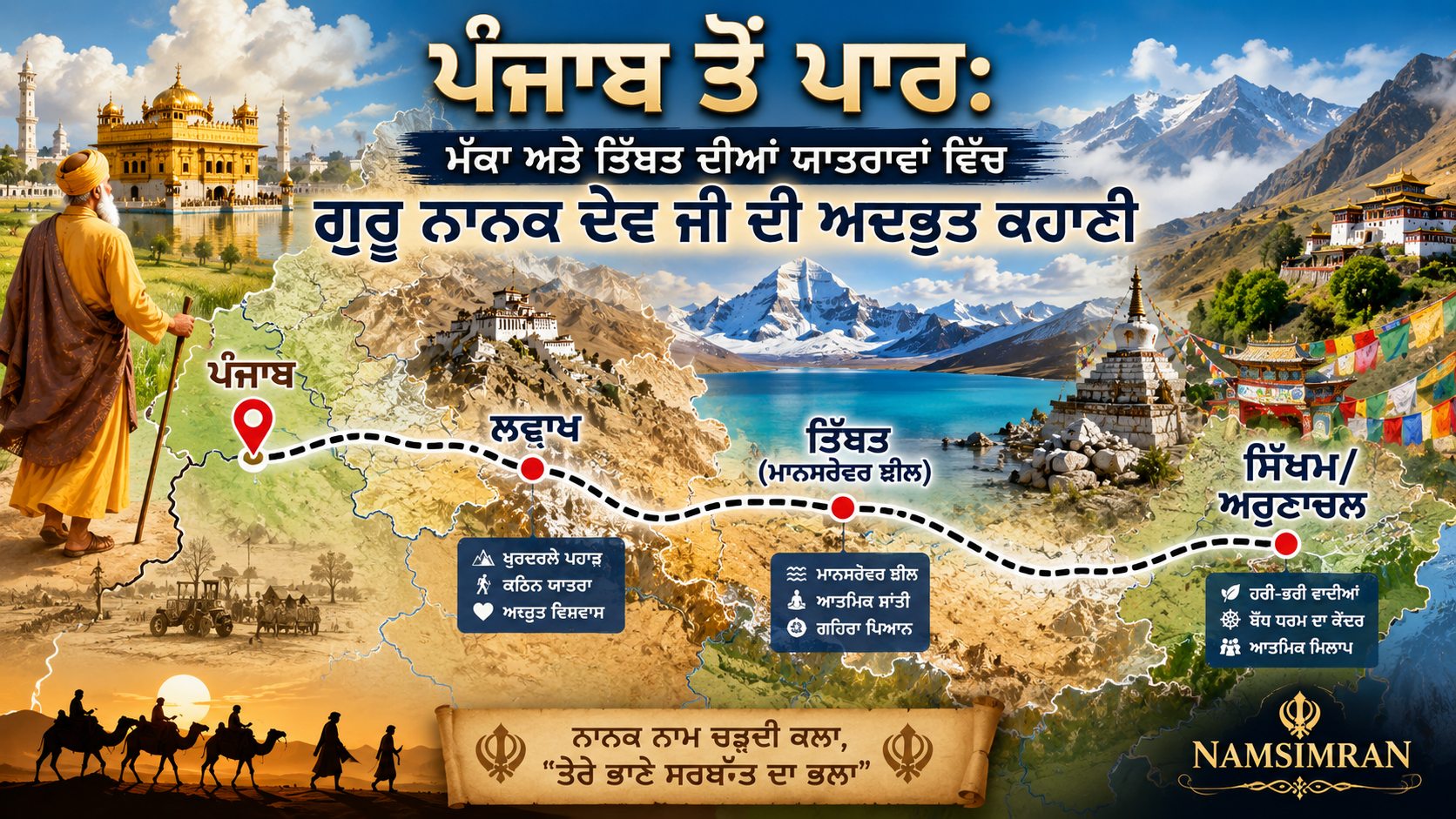
The Miracle at Gurudongmar Lake
High up in Sikkim, near the Tibetan border, sits Gurudongmar Lake at an altitude of over 17,000 feet. The local yak-herders approached Guru Nanak with a desperate plea: during the brutal winters, the entire lake froze solid, leaving them with no drinking water.
Guru Nanak touched a portion of the frozen lake with his walking stick. Local folklore dictates that that specific spot has never frozen since, even when temperatures drop to 30degree. Today, the lake remains a major pilgrimage site for both Sikhs and Buddhists.
Bridging Sikhi and Buddhism
In Tibet, Guru Nanak engaged in deep philosophical debates with Buddhist Lamas near Lake Mansarovar. The Lamas were astonished by his teachings. While they believed in shedding the ego to attain Nirvana, Guru Nanak showed them that this didn't require abandoning society or living as an ascetic in a cave. He taught that one could remain enlightened while actively serving humanity (Seva) within the world.
Why These Travels Matter Today
In a world that feels increasingly polarized, Guru Nanak’s travels offer a beautiful blueprint for humanity.
He didn't travel to convert: Guru Nanak did not go to Mecca to make Muslims into Sikhs, nor did he go to Tibet to convert Buddhists.
He traveled to awaken: His goal was to make Muslims better Muslims, Hindus better Hindus, and Buddhists better Buddhists by reminding them of the core essence of spirituality: love, equality, and truth.
By stepping outside the comfort zone of Punjab, Guru Nanak proved that truth has no country, faith has no borders, and the Divine belongs to everyone.